Sorbet
2021-02-23
I was watching an episode of "Street Foods: Latin America" (imdb), specifically about La Paz, Bolivia. In it, the focus of the mini-documentary mentions that the cinnamon sorbet she serves doesn’t last as long as it used to. She details how they used to get ice from donkeys coming down from the mountains nearby. At this point she injects these lines;
But the weather isn’t the same as before.
Before, the sun would be warm. Now it burns. And the sorbet melts immediately.
We have been affected by global warming.
This made me cock my head. Could that be right? Can global warming melt ice cream noticeably faster, by raising the temperature by a degree?
Temperature History
I looked up the temperature history for La Paz. Unfortunately I couldn’t find a single unified chart for all recorded temperatures, but was able to find historical data for La Paz (Bolivia, not Mexico, if you go looking) going back to 1996 on wunderground.
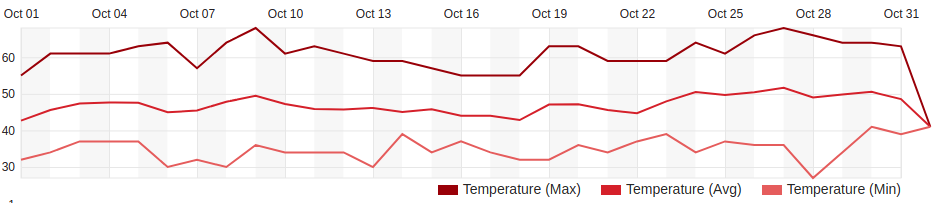
The hottest time of the year in La Paz is October/November. I sampled the temperatures from those months every five years going back to 1996. It’s not great data, I bet some other years/months enjoy some larger delta between samples, but "burning sun" melting sorbet to the point where it’s not feasible should be visible in the hottest months, when people want sorbet most, right? If it was a gradual change she noticed over the years (without the benefit of data), it ought to be visible with even a casual sampling. Especially with the rate of CO2 increase in the atmosphere over that 25-year time period.
2020
2015

2010

2005

2000

1996

There’s two things to note here;
Spotty data. The outliers at which it goes down to 0 or up to 85 indicate either missing data or clearly erroneous readings changing min/max. I wasn’t able to find anything about the conditions in which these measurements were taken (other than that they were at the airport) or if something happened to wunderground’s data, but it seems quite safe to ignore these outliers.
It hasn’t increased. The temperature average across all days in October, at these five-year samples, has remained the same. There are hotter days and colder days, but there is no trend.
Now, I want to stress how casual this is. I’m pulling publicly available data from a website that, well, might not be the best. I’m lazy and only sampling one month every five years, and I’m not even analyzing the table itself. This is eyeballing at best. But you know what? So is what she did. I’m not sure if she really believes it’s hotter, but she said it confidently to the camera, knowing this was going international. I guarantee she hasn’t even done this much work, let alone a proper analysis.
Hottest Days
But this can’t be right, after all it was big news when Bolivia tied its all-time heat record in 2010. The temperatures shouldn’t be in the sixties, they should be in the hundreds. However, that article names Villamontes as the place that recorded the temperature - Villamontes is hotter, because it’s on the other end of the nation, in a different climate.
The blog notes that this means that 33% of all countries have seen record highs, almost 20% of the total land area on earth. You’d think that the same country would see an average increase between two places, right? Well, no. Because average temperature has not seen record highs on 20% of the total land area on earth - specific parts of 33% of countries have seen record highs. Villamonte having a hot day does not mean all the land in Bolivia was hot. Weather Is Not Climate. Using local spikes to extrapolate a global (20% of land mass, remember) trend is just as unscientific as using local lows to extrapolate that nothing has warmed. These are anecdotes, not evidence.
Why Bother?
I wanted to write this down as examples of superstition and bad science that turn open-minded people away from faith in climate change. A street vendor in Bolivia exaggerated her woes to appeal to an international audience who will applaud a bold, strong female character overcoming obstacles. A weather blogger and meteorologist makes wild claims that the data he’s citing doesn’t support to get traffic to his site. The public sees these things, they’re not nescient of it. If you truly care about spreading the word on climate change, this is not helping that cause. It’s hurting it. Don’t presume that nobody will do even a cursory examination of your claims.
Don’t lie to people, they’ll find it out. Even if you’re doing it in good faith of a greater truth, don’t lie to justify it.
